Live Blackjack in New Zealand: Rules and Play
 Available in US
Learn how card values, table rules and practice conditions shape online blackjack and what to assess before placing a wager.
Table of Contents
- The Rules That Shape a Live Blackjack Hand
- New Zealand’s Online Casino Licensing Framework in 2026
- Live-Dealer Blackjack Compared with RNG Blackjack
- What Free Play Can—and Cannot—Tell You
- Playing Live Blackjack Online: Payouts and Table Rules
- Choosing a Live Blackjack App by Its Table Rules
- Bitcoin, Bonuses and the Conditions to Check
- How a Live Blackjack Hand Works
- Assessing a Live Table Before You Gamble
- Card Counting at Live and Online Tables
The Rules That Shape a Live Blackjack Hand
Blackjack is a contest between you and the dealer, not a competition against the other people at the table. The aim is to finish with a hand closer to 21 than the dealer’s hand, without going over 21 yourself. Reaching a higher total is not enough if your hand exceeds that limit: a hand that goes over is bust, and it loses.
The card values are straightforward, with one important exception. Number cards count as the number printed on them, while jacks, queens and kings each count as 10. An ace can count as either 1 or 11, depending on which value helps the hand without taking it over 21. That flexibility makes an ace useful, but it does not guarantee a strong hand: its value can change as more cards are dealt.
Reading your total
A hand with an ace is often described as “soft” when the ace can still count as 11 without the total exceeding 21. If counting it as 11 would push the hand over, the ace can instead count as 1. A hand without that flexible ace is commonly called “hard”. These terms describe how much room the hand has to take another card; they do not alter the target.
If you’re looking for live blackjack in New Zealand in 2026, use this list as a starting point and check each casino’s current game availability and terms before you play.
License: Malta Gaming Authority, licence no. MGA/B2C/394/2017 N1 Casino is listed with a Malta Gaming Authority licence, No. MGA/B2C/394/2017. The details provided do not specify its live blackjack offering.
Payout speed: 1-3 business days Lamabet lists a payout speed of 1–3 business days. No operator-specific live blackjack or licensing details are provided here.
Payout speed: 1-3 business days Wintino lists a payout speed of 1–3 business days. No operator-specific live blackjack or licensing details are provided here.
License: Malta Gaming Authority, licence no. MGA/B2C/370/2017 Play Grand is listed with a Malta Gaming Authority licence, No. MGA/B2C/370/2017. The details provided do not specify its live blackjack offering.
License: Tobique Gaming Commission, licence no. 0000091 7Bit Casino is listed with a Tobique Gaming Commission licence, No. 0000091. The details provided do not specify its live blackjack offering.
License: Tobique Gaming Commission, licence no. 0000064 Neospin is listed with a Tobique Gaming Commission licence, No. 0000064. The details provided do not specify its live blackjack offering.
License: Tobique Gaming Commission, licence no. 0000002 Ricky Casino is listed with a Tobique Gaming Commission licence, No. 0000002. The details provided do not specify its live blackjack offering.
License: 07017519840 · Payout speed: 1-3 business days Zotabet has the licence identifier 07017519840 and lists a payout speed of 1–3 business days. The details provided do not specify its live blackjack offering.
License: Curaçao Gaming Authority, licence no. OGL/2024/165/0185 BitStarz is listed with a Curaçao Gaming Authority licence, No. OGL/2024/165/0185. The details provided do not specify its live blackjack offering.
For instance, a hand containing an ace and a card worth 6 can total 7 or 17. If another card would make the higher total exceed 21, the ace can count as 1 instead. By contrast, a hard total has no ace that can be reduced in value to keep the hand within the limit. The distinction matters because the same next card may leave one hand playable while making another bust.
Keep track of the total after every card rather than treating the ace as fixed from the start. It is not a separate bonus card or a guaranteed route to a strong hand. Its value is adjusted to fit the hand, and that adjustment can stop being available as the total grows.
Your choices and the dealer
During a hand, you decide whether to take another card or keep the total you have. Taking a card is called hitting; keeping your current total is standing. You may also be able to double down or split, depending on the situation and the table’s rules. Those choices change how you continue the hand, but they do not change the central test: avoid going over 21 while trying to finish ahead of the dealer.

The dealer is your opponent, and the comparison with the dealer’s final hand determines the result. A high total is not automatically a win; what matters is how your total compares with the dealer’s, and whether either hand has gone over. This is why a decision cannot be judged only by whether the next card happened to help. A sensible choice can still be followed by an unfavourable card, while a risky choice can sometimes work out. The outcome of one hand does not, by itself, show whether the decision was sound.
For a newcomer, the useful starting point is to separate what you know from what you do not. Your own total is visible and can be calculated from the cards in front of you. The dealer’s eventual total is not yet known while the hand is in progress. Every choice is made with that uncertainty in place; there is no move that removes the chance of an unfavourable result.
Keep the objective in view
Live blackjack can look busy, especially when a dealer is managing cards and several people are seated at the same table. The basic arithmetic remains the same whether you are playing a single hand or watching other hands unfold: count number cards at face value, count face cards as 10, and treat an ace as 1 or 11 according to the total. Other players’ decisions do not replace yours. You are still trying to beat the dealer without exceeding 21.
Remember that the basic arithmetic remains the same: number cards are face value, face cards are 10, and an ace is either 1 or 11 depending on the total.
This foundation also helps distinguish a decision from a superstition. There is no “trick” that changes a card’s value or removes the risk built into choosing whether to take another card. A hand that looks comfortable can become a bust, and a hand that seems weak may improve. The rules define the available choices; they do not promise a particular result.
For a first look at live casino blackjack rules, focus on the hand total and the dealer as your opponent before considering anything else. Learn what each card contributes, notice when an ace can still count as 11, and remember that 21 is a ceiling as well as a target. The names of the available actions are useful, but understanding the aim gives those decisions their meaning.
New Zealand’s Online Casino Licensing Framework in 2026
New Zealand’s approach to online casino regulation changed in 2026. The Online Casino Gambling Act 2026 created the country’s first domestic licensing system for online casino gaming. For anyone considering live blackjack online, the distinction matters: the framework identifies which public bodies oversee the system and which body handles licence applications. It does not mean that every casino available to New Zealanders is already licensed under the new regime.
The Department of Internal Affairs (DIA) is the primary gambling regulator in New Zealand and oversees regulation of the online casino licensing framework. The Gambling Commission has a separate licensing role: it issues online casino licences, decides casino licensing applications and approves changes to licence conditions. In practical terms, the DIA oversees the framework, while the Commission makes decisions about applications and licences.
That division is worth keeping clear. Saying that the DIA oversees regulation does not mean it is the body that grants online casino licences. Nor does the Commission’s role in licensing make it the sole regulator of gambling in New Zealand. Each agency has a distinct responsibility within the system.
A new regime with a transition period
The Act took effect on 1 May 2026. Its transition provisions allow online casinos that were already providing services to people in New Zealand before that date to continue operating until 1 December 2026. This is a temporary arrangement, not evidence that those providers have already received a domestic licence.
The transition has a defined end point. Providers that were not operating in the New Zealand market before the Act took effect do not qualify for the same continuation arrangement. Existing providers may continue during the transition, but the broader licensed regime is not expected to be fully operational until 2027. The new system is therefore being introduced in stages rather than arriving as a complete licensing market on the Act’s commencement date.
The Act also sets a consequence for providers that have not applied for a licence by the end of the transition: they must stop conducting online casino gambling in New Zealand by 1 December 2026. If a provider’s application is declined, it must cease its online casino gambling operations in the country and leave the market. These requirements concern providers and their ability to operate; they are not a description of blackjack rules or table conditions.
Licensing Deadline
Providers that have not applied for a licence by the end of the transition must stop conducting online casino gambling in New Zealand by 1 December 2026.
The transitional period also carries an advertising restriction. Online casino gambling services must not be advertised to people in New Zealand during this period. That is separate from the question of whether a provider can continue operating under the transitional provisions. Permission to continue temporarily should not be read as permission to promote services to New Zealand customers.
Why the earlier position was different
Before the 2026 Act, online casino gambling supplied from outside New Zealand was not licensed or supervised by a New Zealand regulator. The Gambling Act 2003 does not permit online casinos to be based in New Zealand, and domestic online casinos were prohibited. The new law establishes a domestic licensing regime for online casino gaming, but it does not erase the difference between the earlier period and the system now being introduced.
A customer who wagered with an offshore website during the earlier, unsupervised period had no domestic government recourse. That is a material part of the regulatory history: access to a website was not the same thing as oversight by a New Zealand authority. The change in 2026 is the creation of a local framework, with licensing decisions assigned to the Gambling Commission and oversight of the framework sitting with the DIA.
For readers comparing places to play live blackjack, a provider’s presence in the market during the transition should not be mistaken for a completed licensing decision. The transitional rules allow qualifying existing providers to continue temporarily; the Commission remains responsible for deciding applications. Whether a provider has applied, whether its application is approved and what conditions attach to any licence are matters of regulatory status, not features of the blackjack game itself.
The timing also matters when interpreting claims about the market. The legislation is in force, but the full licensed system is expected to become operational in 2027. A reference to New Zealand’s new framework in 2026 therefore describes a system in transition, not a finished market in which every operating provider necessarily holds a domestic licence. The relevant public bodies are identifiable now, even as the licensing regime continues to take shape.
Live-Dealer Blackjack Compared with RNG Blackjack
The main difference between live-dealer blackjack and an online game run by a random number generator (RNG) is how the cards are produced and presented. In an RNG game, software shuffles the cards. In a live game, a dealer uses physical cards at a casino table, and a stream shows the action. Both formats let you play blackjack online, but they offer different rhythms and ways of seeing the game.
A streamed table and a software game
A live table gives you a view of a dealer handling actual cards. That can make the experience feel closer to sitting at a casino table: the cards are dealt in front of you rather than represented solely by software. The stream is part of the game, so you watch the action unfold as it happens.
Uses a stream to show a dealer handling physical cards at a casino table, providing an experience closer to a physical casino.
Uses software-generated shuffles and a direct interface, allowing for faster play and more immediate decisions.
That format brings a practical complication. Video takes time to reach your screen, and streaming can delay the game. A pause may therefore be part of the connection between the table and your device, rather than a change in the rules. The pace is also shaped by the live dealing process.
An RNG game replaces the streamed dealer and physical cards with software-generated shuffles. It allows faster play than a live-dealer game, so decisions and successive rounds can move along more quickly. If you prefer a direct interface without waiting for a stream, that may suit you better. The trade-off is that you do not see a human dealer handle actual cards.
Neither format is automatically the better choice. They differ in presentation and pace, not in whether one can promise a particular result. A stream may feel more like a casino table, while software play can be more immediate. Which matters more depends on what you want from the session.
Pace is part of the choice
The faster pace of RNG blackjack can make it easier to move from one decision to the next. That convenience also means the game can progress quickly. Before choosing it, consider whether you are comfortable with that tempo and whether you can keep your attention on the session.
Live play tends to include the time needed for the dealer and the streamed table to proceed. A connection delay can add further waiting. If you are choosing live blackjack in New Zealand, the same practical point applies as elsewhere: the stream is not merely decoration around an instant software game. It is how you see the physical cards being dealt, and it can affect how promptly the next stage appears on your screen.
A delay does not, by itself, tell you that the game’s rules have changed. It does mean that you should be prepared for pauses and avoid treating every wait as a sign that you need to act differently. If a stream is interrupted or unclear, continuing without knowing what has happened is not a useful way to make a decision.
Compare the conditions, not just the look
Live tables may require higher bets than RNG games. That possibility matters when you are deciding whether a streamed format fits your budget. Do not assume that a live table is affordable simply because it is available online; check the displayed table conditions before you join. If the required bet is not comfortable, a faster software game or another table may be a more suitable option.
Likewise, speed alone is not a reason to choose RNG blackjack. Faster rounds can mean less time between decisions, whereas live dealing can make a session feel more measured, though streaming delays may add unplanned pauses. Think about whether you value seeing actual cards, a quicker software-driven pace, or a table whose betting conditions fit what you are prepared to spend.
The comparison is therefore about the experience and practical constraints. Live-dealer blackjack brings physical cards and a streamed casino-table setting, with possible delays and higher betting requirements. RNG blackjack uses software shuffles and supports faster play. Knowing that distinction can help you select a format deliberately rather than assuming that online blackjack always works in the same way.
- Check displayed table conditions before joining
- Consider if you prefer a measured pace or immediate play
- Verify if betting requirements fit your budget
- Assume live tables are automatically affordable
- Treat streaming delays as changes in game rules
- Choose RNG blackjack solely for its speed
What Free Play Can—and Cannot—Tell You
A no-cost mode can sound like a low-risk way to get comfortable with blackjack. If a game offers one, it may let you become familiar with the decision buttons and the order in which choices appear. That can make the interface less distracting when you later encounter a table where money is at stake. It is not, by itself, evidence that the game reproduces every condition of a live table.
The basic decisions are straightforward to name: you can hit, stand, double down or split. Free play may give you a place to see how those options are presented, if they are available in that mode. But pressing a button in a practice setting does not establish that the same action will be offered in every real-money game. Table rules govern what you can do, and a practice version may not be configured to match a particular table.
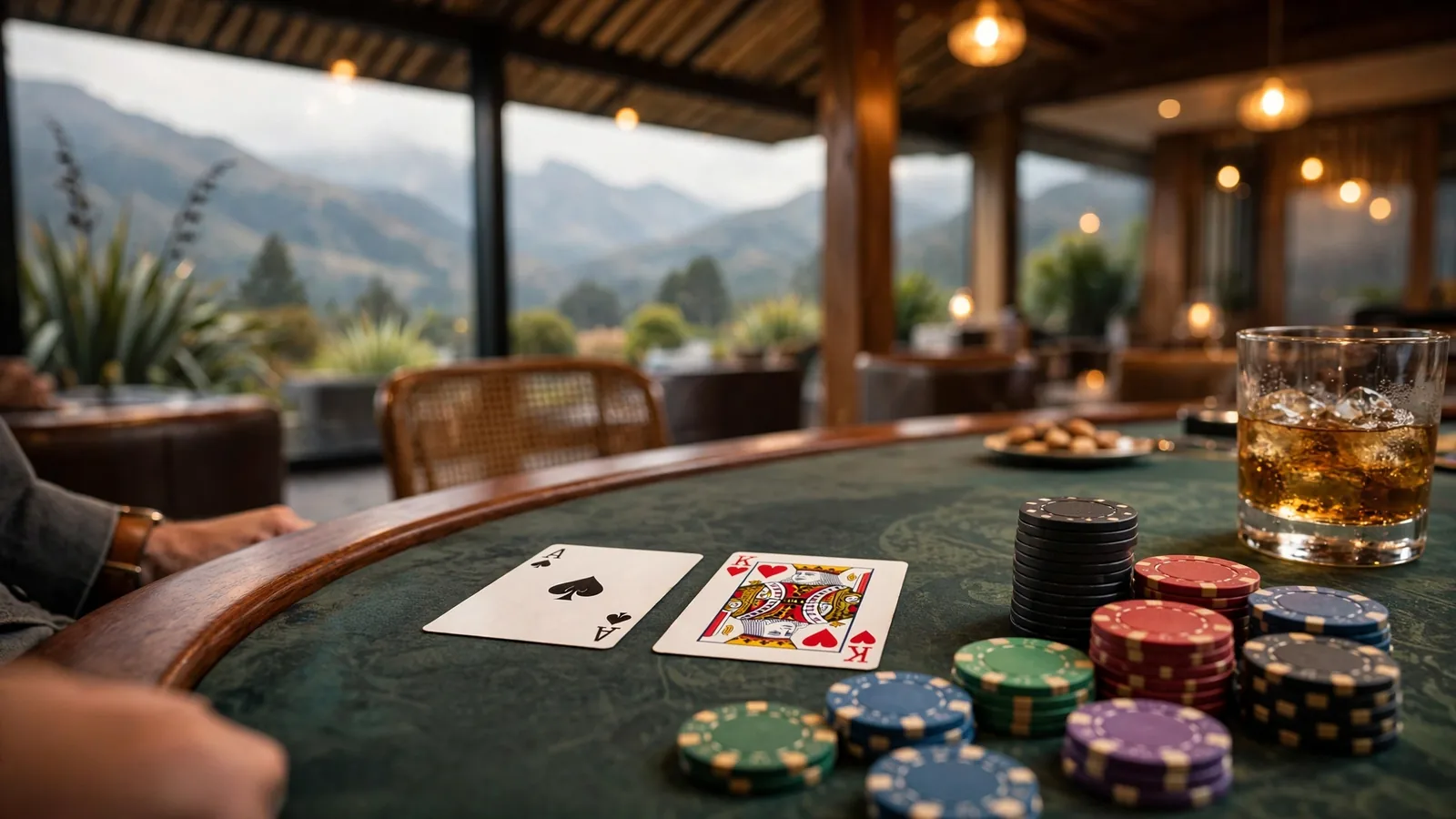
There is also a difference between learning where an option is and learning when it makes sense to use it. A free-play hand can help you follow the interface, but repeated play alone does not explain the reasoning behind a decision or show that a choice will produce a winning result. Blackjack outcomes vary from hand to hand. Treat practice as a way to become more familiar with the flow of play, not as proof of a reliable system.
The word “live” deserves care here. A free-play label does not, on its own, tell you whether cards are being dealt by a live dealer, whether the game uses a simulated format, or whether the experience matches the conditions of a real-money live table. Nor does it establish that a free mode is available for every game. Check the game information rather than inferring its format from the label.
Free play also cannot settle questions about real-money terms. It does not tell you what a table pays, what its rules are, or whether a particular action is permitted there. Those details belong to the table you intend to use, not to a general impression formed in practice. A free mode may be useful for exploring an interface, but it should not be treated as a substitute for reading the rules before wagering.
If you move from practice to real-money play, make that a separate decision. Set a budget you can afford to lose and do not chase losses by increasing it. Familiarity with the buttons can reduce uncertainty about how to act on screen; it cannot remove the financial risk or make a hand predictable.
The sensible measure of live blackjack free play is therefore modest. It can help you recognise the available controls when the mode provides them. It cannot guarantee that a later table will work the same way, teach a dependable winning method, or tell you whether its real-money conditions suit you. Those limits matter more than the reassuring word “free”.
Attention Free play is a tool for exploring the interface and flow of play; it cannot teach a dependable winning method or guarantee that real-money tables work the same way.
Playing Live Blackjack Online: Payouts and Table Rules
Before joining a live blackjack table for real money, read its rules and paytable rather than assuming every game uses the same terms. A natural blackjack—a starting hand consisting of an ace and a ten-value card—may receive a different payout from other winning hands. A specialist review describes both 3:2 and 6:5 payouts for natural blackjack at different tables. Treat those as possible table terms, not as a guaranteed standard: the displayed rules for the game you select are what matter.
The difference affects the return on a natural, so compare the payout before you play. A familiar-looking table name or layout does not establish what it pays. If the paytable is hard to find, unclear, or inconsistent with the rules shown elsewhere, pause rather than guessing. The details are part of the game, not fine print that can safely be ignored.
Payouts are only one part of the comparison. A specialist review also notes that games can differ in deck count, in whether the dealer draws on a soft 17 or stands, and in whether surrender is permitted. A soft 17 is a hand containing an ace counted as 11 that totals 17. Such rule differences can change how a hand should be played, so a strategy that fits one table may not fit another. Check the rules attached to the specific table, not just general blackjack guidance.
Pay particular attention to conditions that may be presented in short labels or tucked into a rules panel. “Dealer stands on soft 17” and “dealer hits soft 17” describe different procedures; neither label tells you the natural-blackjack payout. Likewise, a stated payout does not reveal whether surrender is available. Read each point separately, and make sure you understand any rule that could affect your decisions or the amount returned on a winning hand.
A practical check before you sit down is to locate the payout information and the table rules, then confirm that the terms apply to the game currently open. If the information is absent or difficult to interpret, choose not to commit money until it is clear. Live presentation can make tables look similar, but appearance is not a substitute for their specific conditions.
If you are comparing real-money tables, use the same checklist for each: natural-blackjack payout, deck information, dealer action on soft 17, and surrender availability. The point is not to find a table with a label that sounds favourable, but to know what its rules actually say before wagering. Keep a budget for gambling and do not chase losses; a different payout or rule set does not make a result certain.
Choosing a Live Blackjack App by Its Table Rules
A live blackjack app is worth assessing by the rules it makes available, not by its name or presentation. Before choosing a table, look for a clear explanation of how the game is played. If the rules are hard to find or leave important details unanswered, you cannot make a sound comparison with another table.
Assessing a Table
- Locate the clear explanation of how the game is played
- Verify the number of decks used
- Check if the dealer hits or stands on soft 17
- Confirm whether surrender is allowed
- Check the natural blackjack payout
Rule differences can change both the decisions available to you and the house edge: the portion of wagers the casino expects to retain over time. Check the number of decks used, whether the dealer hits or stands on soft 17, and whether surrender is allowed. A soft 17 is a hand containing an ace counted as 11 that totals 17. These details matter because a strategy that suits one set of rules may not suit another.
The payout for a natural blackjack is another point to verify in the table’s own rules. A specialist review may describe a particular table, but its details should not be treated as a permanent statement about every game in an app. Rules can differ from table to table and may change, so rely on the information presented for the game you intend to play.
Do not assume that a live table follows familiar rules simply because it looks like blackjack. Compare the written terms before you join, and make sure they cover the details that can affect your choices and the game’s house edge. If a rule is unclear, treat that uncertainty as a reason to pause rather than guessing.
The idea of finding the “best” live blackjack app can suggest that one choice suits everyone. In practice, the useful comparison is between the rules you can verify and the kind of play you are comfortable with. Clear information lets you judge the trade-offs; it does not turn a table into a reliable way to win.
If you decide to play for money, set a budget beforehand and do not chase losses. The app’s presentation cannot change the underlying rules, and knowing those rules is more useful than relying on a label or a promise.
Bitcoin, Bonuses and the Conditions to Check
A bonus attached to a live blackjack offer can look like extra playing funds, but its value depends on the conditions attached to it. Read the terms before accepting it, and check the operator’s own rules rather than relying on a banner or summary. A headline offer cannot tell you how blackjack is treated when wagering requirements apply.
Wagering requirements set out how much play is required before bonus-related funds can be withdrawn. The contribution assigned to blackjack may differ from the contribution for other games, so playing blackjack may clear a requirement more slowly than the headline suggests. Check whether live blackjack is eligible at all, and whether particular tables or game types are excluded. If the terms are unclear, do not assume that every hand counts in the same way.
Pay particular attention to maximum-bet rules while wagering requirements are active. A bet above the stated maximum may affect your eligibility for the promotion or any resulting winnings. The permitted bet can be described in the full terms rather than on the offer page, so read the detailed conditions before you play. Also look for rules about when the offer ends, what happens if you withdraw early, and whether you must opt in.
When using a bonus, always check for maximum-bet rules and the specific wagering contribution assigned to blackjack, as it may differ from other games.
The phrase “Bitcoin live blackjack” does not establish that a particular casino accepts Bitcoin, or that a bonus can be used at a live table. Check the payment terms and promotion terms separately. Confirm whether Bitcoin is accepted for the relevant transaction, whether the bonus applies to funds deposited that way, and whether any payment method is excluded from the offer. Do not assume a bonus is available just because a site mentions cryptocurrency or live blackjack.
A bonus is not a reason to increase your stake or keep playing after you have reached your budget. Set a spending limit before depositing, and do not chase losses to meet a wagering requirement. If the conditions make it difficult to understand when funds can be withdrawn, declining the offer is a reasonable choice. A promotion should be judged by its usable terms, not by the size of its headline.
How a Live Blackjack Hand Works
A live hand is a sequence of choices made after the cards are dealt. You act on your own hand while playing against the dealer; the aim is to finish closer to 21 without going over. The options available can depend on the table’s rules, so check them before joining rather than assuming every game works the same way.
Hit means asking for another card. You can take a hit when you want to improve your total, but another card can also take you over 21 and end your hand. You may take further cards if the table permits and you choose to continue.
Stand means keeping your current hand and taking no more cards. Your choice is then complete, and the dealer’s hand is compared with yours under the game’s rules. Standing is not a promise that your hand will win; it simply avoids the risk of drawing another card.
Double down lets you increase your stake in exchange for a restricted continuation of the hand. The precise conditions, including when the option is available and what happens after you use it, should be stated in the table rules. Because it commits more money to that hand, it is worth understanding those conditions before clicking.
Split may be available when your first two cards form a pair. It separates them into two hands, each played independently, and can require an additional stake. Whether you can split particular pairs, or split again, depends on the table. Do not assume that a split gives you the same options as an ordinary hand.
Some tables also allow surrender. This lets you give up the hand rather than continue, subject to the table’s conditions. It is not available everywhere, and the rules determine when you can use it and what happens to your wager.
In a live game, make each decision using the controls shown for the current hand, and pause if an option or its cost is unclear. The fact that a button appears does not make its consequences obvious. Your decisions also do not change the table’s payout terms; those are separate rules to read before play.
- Hit to improve your total, but risk going over 21
- Stand to keep your current hand and avoid further risk
- Double down to increase your stake for a restricted continuation
- Split pairs into two independent hands when permitted
- Surrender to give up the hand according to table conditions
Set a spending limit before starting and do not chase losses by adding money after an unfavourable run. If you are wagering under a bonus, check whether blackjack contributes differently to wagering requirements and whether maximum-bet rules apply while wagering.
Assessing a Live Table Before You Gamble
A table’s label tells you less than its rules. Before joining a live blackjack game, look for the details that determine how a hand is played and how its outcomes are settled. Blackjack variants can differ in ways that change both the decisions available to you and the house edge—the casino’s mathematical advantage over time. A familiar-looking layout is not proof that two tables play alike.
Check how many decks are used and what the dealer does on soft 17, a hand containing an ace counted as 11. Whether the dealer hits or stands on that hand can affect the choices that make sense for you. Look for the surrender rule, too: surrender is not available at every table, and its availability changes the options in particular situations. The table’s stated blackjack payout is another comparison point. Do not assume that a payout or rule from one game carries over to another.
A specialist review describes variation in deck count, soft-17 rules, surrender and payouts across games. Treat that as a prompt to verify the rules shown for the specific table, not as a guarantee about every live game. If a rule is not clear before you sit down, avoid guessing at its effect; find an explanation or choose a table whose terms are readable.
There is no single “best” live table for every player. A rule set that changes a decision may suit one approach less than another, and the house edge can shift with the variant. Compare the actual rules rather than relying on a game name or appearance, and do not treat any combination as a method for ensuring a win. Set a gambling budget before you play, and stop rather than chasing losses.
Card Counting at Live and Online Tables
Card counting means keeping a mental estimate of which kinds of cards have already appeared, then using that estimate to inform decisions. In New Zealand, counting cards through mental calculation is not illegal. That does not make it a dependable way to win, or mean that every online format gives you useful information to count.
At a live-dealer table, cards are dealt physically and the game is streamed. You can see cards as they are revealed, but a stream is not the same as sitting at the table: delays can affect what you see and when. The dealer’s visible cards and the cards exposed during play do not reveal the full composition of the remaining pack. Any estimate is therefore incomplete, and the table’s procedures can limit how much a count tells you.
RNG blackjack works differently. RNG means random number generator: software determines the card outcomes, and the game uses software shuffles. These games can move faster than live-dealer tables, but speed is not an advantage for card counting. Where software shuffles are used, remembering previous hands does not provide a reliable basis for predicting what comes next. Treating an online count as a system that can overcome that process would overstate what the information can do.
A count is also not a guarantee, even when cards are visible. It cannot remove chance from individual hands or ensure a profit. Avoid increasing bets simply because a mental estimate seems favourable, and do not chase losses after an unsuccessful session. Set a budget before playing and stop when you reach it. The legal point is narrow: mental arithmetic itself is not prohibited. It should not be confused with proof that counting is effective at an online casino, particularly in RNG games.
What is card counting?
Card counting is keeping track of cards through mental calculation.
Is card counting illegal?
No. Card counting using only mental calculation is not illegal under New Zealand law.
Does blackjack always pay 3:2?
No. A natural blackjack often pays 3:2, but some tables pay 6:5.
Created by the ”Casinosbonusesinfo” editorial team.