Blackjack for Real Money in New Zealand
 Available in US
Learn how hits, stands, doubles and splits shape a hand, alongside the practical details of playing online for real money.

Table of Contents
- How Online Blackjack Works: Cards, Decisions and the Dealer
- Playing for Real Money on a Phone: What Changes
- Real-Money Blackjack in New Zealand: The 2026 Licensing Change
- Deposits, Currency and Table Minimums
- Can You Make Money Playing Blackjack?
- Strategy That Limits the House Edge
- Choosing a Blackjack App Without Confusing It with a Strategy
- House Money, Side Bets and Playing on iPhone
- What “Real-Money Blackjack” Means at the Table
- Live Blackjack: The Stream, the Shoe and the Trade-Offs
How Online Blackjack Works: Cards, Decisions and the Dealer
Blackjack is a contest between your hand and the dealer’s. The aim is to reach a total of 21, or get closer to it than the dealer, without going over. If your total exceeds 21, your hand is bust and cannot beat the dealer’s hand. A higher total does not help if it crosses that limit; a lower one does not win simply because it is close to 21.
A round begins with two cards dealt to each player and two to the dealer. Players’ cards are dealt face up. In many versions, the dealer’s cards are split between one face-up card and one face-down card. The visible card gives you some information, but the dealer’s complete hand is not known at the start of your turn.
You make decisions in sequence, using the controls shown at the table. The available choices are hit, stand, double down and split. They are not four different ways to end a hand: each changes what happens next.
Hit means taking another card. You can continue to request cards, but each one changes your total and brings the risk of going over 21. Stand means taking no more cards and keeping your current total. Once you stand, your part of the round is finished; the dealer then completes the hand according to the table’s rules.
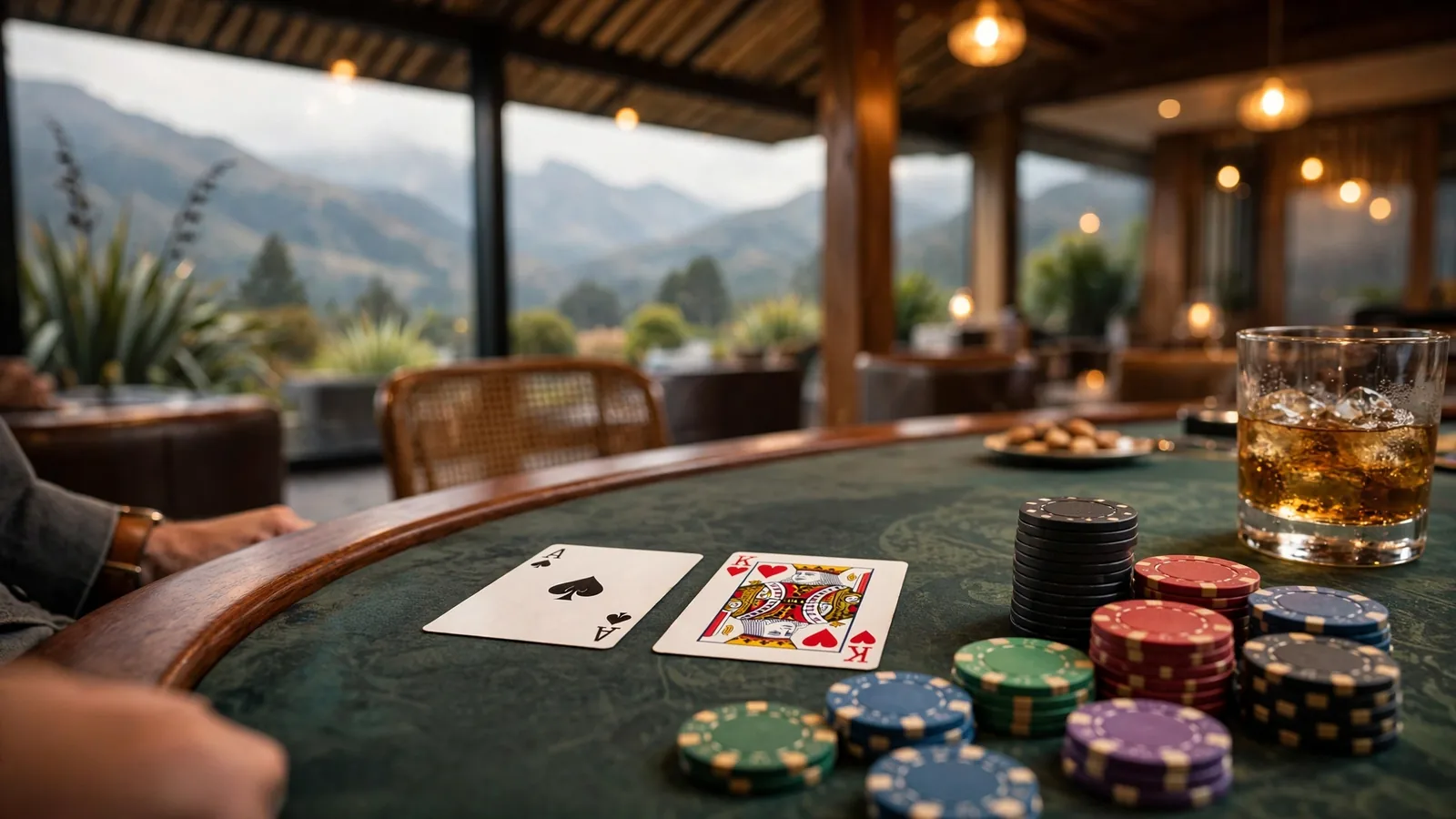
Double down changes the course of a hand by letting you double your bet and receive one additional card. The choice is therefore not just about the card you hope to draw: it also commits more money to that hand. Split is available when your first two cards form a pair. It separates them into two hands, each played on its own. That creates a second outcome to manage, rather than improving the original hand as a single unit. The table interface indicates which actions are available at a given moment.
After players have finished, the dealer reveals the hidden card and plays out the dealer’s hand. The dealer’s decisions are not made in the same way as a player’s: the rules set out when the dealer must draw and when they must stop. The round ends when the players’ hands and the dealer’s hand can be compared. A player must beat the dealer without exceeding 21 to win; if the dealer goes over, a player who has not gone bust can win. The exact settlement of a hand depends on the table’s rules.
That basic sequence applies whether the game is software-based or presented with a live dealer. The main difference is how the cards are produced and how the round is delivered to you.
In online RNG blackjack, RNG means random number generator: software determines the card results, using software shuffles rather than a physical dealer handling cards. You make your decisions through the game interface and see the resulting cards on screen. Because the process does not depend on a streamed table and a dealer conducting each round, RNG games allow faster play than live-dealer games. The underlying choices remain recognisable, but the pace and presentation are different.
Live dealer blackjack has a person conducting the game with actual cards. You still use an online interface to make permitted decisions, while video and on-screen information show the round. The dealer handles the cards; you do not physically touch them. Your choices are entered through the controls, and the dealer carries out the action at the table. Streaming can introduce delays, so the round may not move at the same pace as software play. A specialist review also describes higher bets as a possible feature of live tables, but that should not be treated as a rule of blackjack or a condition of every table.
These formats should not be confused with the difference between playing for money and playing without it. A free-play version can let you learn the order of a hand and see how the controls work without wagering real funds. Blackjack online for real money uses the same central contest—your hand against the dealer’s—but the stakes are not fictional. Playing with no money does not by itself make a game live or software-based: those describe how the cards and round are handled, not whether the result affects your balance.
Software-determined results using a random number generator. Allows for faster play and does not depend on a streamed table.
A person conducts the game with actual cards via a video stream. Offers a more traditional feel but may have streaming delays.
A mode to learn the order of a hand and test controls without wagering real funds. Not tied to a specific game format.
The practical distinction is useful when choosing what to try. If you want to focus on the sequence of decisions, a software game presents the cards without a live table. If you prefer seeing a dealer handle actual cards, the live format provides that, while requiring you to follow the round through a stream. In either case, the controls matter: a hit adds a card, a stand ends your turn, a double down increases the bet for one further card, and a split turns a pair into separate hands. The rules displayed at the table determine which choices you can make and how the dealer completes the round.
Playing for Real Money on a Phone: What Changes
A phone makes it possible to join a blackjack table without sitting at a computer, but the game has to fit around a smaller screen, touch controls and a mobile connection. Those differences matter most when a round is moving quickly or when the table is streamed live. The cards and decisions remain part of blackjack; what changes is how you see and interact with them.
At a software-based table, the game runs on the device or through the casino’s online service, and the cards are generated by a random number generator (RNG). A specialist review estimates that an RNG hand takes 15 to 20 seconds from deal to result. That short interval can make play feel brisk on a phone: rounds follow one another with little pause, and the screen may change before you have taken a moment to check your selection.
Live play has a different rhythm. A specialist review estimates 30 to 45 seconds from deal to result for a live-dealer hand. The extra time reflects a streamed game rather than a faster or slower phone. A dealer conducts the round, while you make permitted decisions through the interface; the video and on-screen information show what is happening. The stream can also introduce a delay between an action and its appearance on screen. On a phone, that can make the experience feel less immediate than software play, even when the controls respond normally.
Screen size affects how comfortably you can follow the table. Cards, totals, buttons and other on-screen information share limited space, and their arrangement may change when you turn the phone. Before acting, take a moment to confirm which control is selected and what the display shows. A quick tap is easy; correcting a tap made in haste is not always part of the round.
Touch input also changes the feel of decisions. A mouse click and a finger tap are not the same gesture, particularly when controls sit close together or when your hand obscures part of the screen. Keep the phone steady and avoid tapping while the display is still changing. If you use a larger text setting or screen magnification, check that the game’s controls remain visible rather than assuming the table will rearrange itself neatly.
- Confirm which control is selected before acting
- Keep the phone steady during input
- Use Wi-Fi to manage mobile-data use
- Pause play if video quality becomes poor
- Tap controls while the display is changing
- Repeat actions if the screen has not refreshed
- Assume the table will rearrange for screen magnification
- Continue playing by guesswork during connection drops
The connection is more consequential for live dealer blackjack because video must reach your device continuously. A specialist review puts live play’s data use at 500MB to 1GB per hour. Treat that as an estimate, not a fixed allowance: stream quality and connection conditions can affect consumption. If your mobile plan has a data cap, a long session could use a substantial part of it. Connecting to Wi-Fi may help manage mobile-data use, though it does not guarantee an uninterrupted stream.
A weak or inconsistent connection can interrupt video or delay updates. That is inconvenient in any online game, but it is particularly noticeable when you are watching a dealer and waiting for the table to move on. If the stream freezes, avoid repeating an action simply because the screen has not refreshed; first check whether the interface has registered it. A dropped connection can also make it harder to tell whether a round is still in progress. Give the game time to update before making another selection.
Battery use deserves attention as well. Live video keeps the screen active and requires a continuing data connection, so a phone that is already low on charge may not be suited to a long session. Lowering screen brightness can reduce drain, although it may also make small details harder to read. Software-based play does not require a live video stream, but a bright display and an active connection still use power.
Playing at home on a phone may feel private and convenient, but the device does not make the activity informal in its consequences. Real-money play involves actual stakes, and a small screen can make it easier to lose track of time or move rapidly from one hand to the next. The faster pace estimated for RNG play is one reason to decide in advance how long you intend to stay at the table. A phone’s portability means the game can travel with you; it does not mean every setting is a good one for paying attention.
Choose a moment when you can see the screen clearly, maintain a stable connection and focus on each action. If video quality becomes poor or the controls are difficult to read, pausing is more sensible than continuing by guesswork. Mobile play removes the need for a desktop, not the need to stay attentive.
Real-Money Blackjack in New Zealand: The 2026 Licensing Change
Choosing a real-money blackjack site means checking the details that matter to you before you play. Use this list as a starting point and verify the current terms for your location.
License: Malta Gaming Authority, licence no. MGA/B2C/394/2017 N1 Casino is listed with a Malta Gaming Authority licence, number MGA/B2C/394/2017. You can use that licence detail as a point to verify when assessing the site.
Payout speed: 1-3 business days Lamabet lists a payout speed of 1–3 business days. If withdrawal timing matters to you, check the applicable terms.
Payout speed: 1-3 business days Wintino lists a payout speed of 1–3 business days. You may want to check the terms for any conditions that apply.
License: Malta Gaming Authority, licence no. MGA/B2C/370/2017 Play Grand is listed with a Malta Gaming Authority licence, number MGA/B2C/370/2017. You can verify this licence detail as part of your checks.
License: Tobique Gaming Commission, licence no. 0000091 7Bit Casino is listed with a Tobique Gaming Commission licence, number 0000091. You can use the stated regulator and licence number as a starting point for verification.
License: Tobique Gaming Commission, licence no. 0000064 Neospin is listed with a Tobique Gaming Commission licence, number 0000064. Check the licence details and the site’s terms before deciding whether it suits you.
License: Tobique Gaming Commission, licence no. 0000002 Ricky Casino is listed with a Tobique Gaming Commission licence, number 0000002. The licence information is the operator-specific detail available here for your checks.
License: 07017519840 · Payout speed: 1-3 business days Zotabet lists licence identifier 07017519840 and a payout speed of 1–3 business days. You can verify the licence information and review the applicable withdrawal terms.
License: Curaçao Gaming Authority, licence no. OGL/2024/165/0185 BitStarz is listed with a Curaçao Gaming Authority licence, number OGL/2024/165/0185. You can use this licence detail when checking the operator.
The rules for online blackjack in New Zealand changed in 2026, but the change is a transition rather than an immediate move to a fully licensed market. The Online Casino Gambling Act 2026 took effect on 1 May 2026, establishing the legal basis for a domestic licensing system. For anyone considering real-money blackjack, the practical question is therefore not simply whether a site displays a licence. It is whether the operator is entitled to serve Kiwis during the stage of the transition currently in force.
Before the Act, online casinos based overseas could serve customers in New Zealand, but those services were not licensed or supervised by a New Zealand regulator. Players had no domestic government recourse in disputes with an offshore website. New Zealand’s existing Gambling Act 2003 also prevents online casinos from being based in the country. The new law creates a local regulatory framework without making domestic online casinos permissible.
Legal Compliance
From 1 December 2026, operators without a New Zealand licence must stop offering online casino gambling to local players.
What the transition means
The Act allows online casinos that were already serving New Zealand customers before 1 May 2026 to continue operating until 1 December 2026, under transitional provisions. That is a temporary allowance for existing services, not a general invitation for new operators to enter the market. If a site claims to be serving New Zealand during this period, its operating history matters: the relevant question is whether it was already providing services to people here before the Act began.
The transition also means that a player should not assume the full licensing system is already operating. The complete regime is not expected to be fully in place until 2027. The law sets out a system with a maximum of 15 licences, but that does not mean every operator currently accessible to New Zealand customers has one, or that a licence can be inferred from a site’s availability.
From 1 December 2026, operators without a licence must stop offering online casino gambling to New Zealand players. Providers that have not applied for a licence by that point must also cease conducting these services in the country. If an application is declined, the provider must leave the market rather than continue operating. Unlicensed operation is expected to become an offence around mid-2027, with enforcement directed at providers, not players.
Which agency does what
The Department of Internal Affairs oversees the regulatory framework and is responsible for allocating the available licences. The Gambling Commission has the role of issuing licences and approving changes to their conditions. These are related but distinct responsibilities: the Department administers the framework, while the Commission makes licensing decisions.
When checking whether an online casino can continue serving local customers, focus on what the operator can substantiate about its status under the transition and, once the licensing system is operating, whether it holds the required New Zealand licence. A general claim that a company is “regulated” somewhere overseas does not establish that it has a New Zealand licence. Nor does being reachable from New Zealand prove that an operator is authorised under the new system.
The timetable matters. During the transition, some previously operating offshore casinos may continue temporarily; after the transitional date, an unlicensed operator must not keep serving the market. Since the full regime is expected to become operational in 2027, claims about New Zealand licensing should be read in the context of when they are made and which stage of the system has begun. A licence is not a decorative badge: it is the basis on which an operator may continue under the new framework.
Deposits, Currency and Table Minimums
Before playing blackjack online for real money, separate three amounts that are easy to confuse: the money you add to an account, the minimum stake at a table, and the amount you choose to risk over a session. A table’s minimum is not a recommended bankroll, and an account deposit does not have to be treated as money available for one uninterrupted run of hands.
Payment Methods
Common options for Kiwis include credit and debit cards, bank transfers, e-wallets (Skrill, Neteller), PaysafeCard, or POLi.
Payment options depend on the casino. Credit and debit cards, bank transfers and e-wallets such as Skrill and Neteller are among the methods accepted by many online casinos serving Kiwis. Some also offer PaysafeCard or POLi. These are not interchangeable: a bank transfer, card payment or e-wallet may have different steps and processing arrangements. Check the cashier’s current payment list before making a deposit, rather than assuming a method offered elsewhere will be available.
The legal status of a provider matters to payment choices, too. Under New Zealand’s licensing framework, licensed operators must not accept credit cards or buy-now-pay-later methods. So a familiar card option on a casino site should not be taken as proof that the site is operating under a New Zealand licence. Payment methods are one detail to verify, not a substitute for checking who is permitted to serve you.
Currency can affect what a deposit costs beyond its face value. Many international casinos let you hold an account in New Zealand dollars. If both the account and your payment are in NZD, there is no foreign-exchange conversion fee attached to playing. If the account uses another currency, conversion may apply; check the currency displayed in the cashier and the terms of your payment provider before confirming. A balance shown in NZD is easier to compare with your own spending, while a foreign-currency balance can make the cost less immediate.
Table minimums vary with the format. A specialist casino review reports that some software-based RNG blackjack tables set minimum bets as low as NZ$0.50 or NZ$1. The same review gives NZ$5 to NZ$25 as the range typically found at live-dealer tables. Treat those figures as reported examples, not a promise that every casino or table will offer them: the amount shown beside a specific table is the amount that applies when you sit down.
That difference can shape how long a fixed balance lasts, even before the cards are dealt. At a lower-minimum table, you can choose a smaller stake per hand; at a higher-minimum table, the smallest permitted wager may already be more than you intended to risk. Decide what amount you are comfortable setting aside, then compare it with the table’s minimum before joining. Do not deposit more simply to make a particular table fit your balance.
If you are looking to play blackjack for money through an app or browser, the payment screen and the game lobby answer different questions. The cashier shows how you can fund an account and in which currency; the table listing shows the minimum stake. Check both, and confirm the final amount before authorising a payment. If a casino promotes a no-deposit offer, read its conditions separately: bonus funds may carry wagering rules or restrictions on which games count. A promotional balance is not necessarily the same as withdrawable cash.
For real-money blackjack games, the useful comparison is therefore not just whether a casino accepts a payment method. Confirm the currency, the applicable payment terms and the minimum at the particular table you intend to use. That makes the amount at stake visible before play begins.
Before Joining a Table
- Verify the account currency to avoid conversion fees
- Check the cashier for available payment methods
- Confirm the minimum stake for the specific table
- Review wagering rules if using a no-deposit offer
Can You Make Money Playing Blackjack?
You can win money in individual blackjack sessions, but that does not mean the game provides a dependable way to earn money over time. A winning hand or a profitable evening is an outcome, not evidence that the odds have shifted in your favour. The distinction is between short-term results and the expected result across many wagers.
The house edge describes the casino’s mathematical advantage under a particular set of rules. It is not a fee deducted from every hand, nor a prediction of what will happen in your next session. A player can finish ahead despite a house edge; over repeated play, however, the edge works against the player. The longer-term expectation is not a promise about any individual’s results.
The figure depends on the table rules and on how the player makes decisions. Under one specific combination—eight decks, a 3:2 natural-blackjack payout, the dealer standing on soft 17, doubling after a split, no surrender, and resplitting to four hands—the house edge with perfect basic strategy is approximately 0.43%. That is a narrow estimate for those conditions, not a general rate for every blackjack table. Change the rules or the decisions, and the estimate may no longer apply.

Payouts matter. If a natural blackjack pays 6:5 rather than 3:2, the house edge rises by approximately 1.4%. That change can make a table materially less favourable, even though the game still looks like blackjack and the hand itself is played in the same way. The payout printed in the rules is therefore relevant to the financial expectation, not just a detail about how a winning hand is settled.
There is no reliable amount you “make” simply by playing blackjack. Your result depends on the wagers you place, the hands you receive, the rules in force and the decisions you make. A higher stake can mean a larger win, but it can also mean a larger loss; it does not remove the house edge. Nor does a winning streak establish that future hands are more likely to pay.
Online blackjack does not change this basic relationship. Software-based games and live-dealer tables can differ in pace and format, but neither format turns a favourable-looking session into a dependable income source. The relevant question is what rules apply and how the game’s expected disadvantage affects repeated wagering—not whether the cards are dealt through software or by a person.
If your aim is to make more money playing blackjack, it helps to separate two ideas: reducing the casino’s advantage and reliably earning a profit. Rule choices and sound decisions can affect the first; they cannot guarantee the second. A table with a lower house edge is less unfavourable under its stated conditions, not a promise that you will leave with money.
Claims about the largest blackjack win are also a poor guide to what you can expect. An exceptional result says little about the likely experience of an ordinary player. Treat any money won as an uncertain outcome, not income you can plan around.
Attention The house edge is a mathematical advantage; while you can win individual sessions, it works against the player over repeated play.
Strategy That Limits the House Edge
Basic strategy is a set of decisions matched to your hand, the dealer’s visible card and the table’s rules. It is not a way to predict the next card or guarantee a win. Its purpose is to avoid choices that are worse, over time, than the alternatives available under the same rules.
Before using a strategy chart, check which rules apply. One key detail is what the dealer does with a soft 17: a hand containing an ace counted as 11 without going over 21. Some tables require the dealer to hit that hand; others require the dealer to stand. Because the dealer’s possible final hand changes with that rule, the recommended player decisions can change too.
The number of decks also matters. A chart built for one deck may not give the right decision for a game using several decks. Find a strategy guide that states its assumptions and compare them with the table rules, rather than treating every blackjack chart as interchangeable. If you cannot establish which rules the guide assumes, its advice may not fit the game you are playing.
Surrender is another rule to check. Where it is offered, surrendering ends the hand and gives up half the bet. It can be a useful option in particular situations, but it is not available at every table; a strategy that includes it cannot be followed where the option is absent. Check the game’s rules before relying on that choice.
These details matter more than a vague search for the best way to win money at blackjack. When you bet real money online, apply a strategy only after matching it to the rules, and make each decision on its own merits. Trying to win your money back after a loss is not a strategy: it can lead you to ignore the hand, the dealer’s card and the rules that should guide the decision.
Basic strategy can limit avoidable errors, but it does not change the game into a reliable source of income. It is a framework for consistent choices, not a promise that you will make money betting on blackjack.
Choosing a Blackjack App Without Confusing It with a Strategy
The best blackjack app for you depends less on a claim of winning more and more on the kind of game it provides. An app is an interface: it may offer software-based blackjack, a live-dealer stream, or both. These formats change the pace and feel of a session, not the decisions that make up a hand.
In RNG blackjack, software shuffles the cards and deals each round. That makes play faster than at a live table, where a dealer handles actual cards and the game is streamed. Faster rounds can mean less waiting, but also less time between decisions. If you prefer to watch a dealer and follow a physical shoe, the live format may suit you better. A specialist review notes that live tables can also bring streaming delays or higher bets; neither feature is a rule of every table, so check the displayed terms before joining.
Live Dealer Data Usage
A specialist review estimates that live-dealer play can consume between 500MB and 1GB of data per hour, depending on stream quality and connection conditions.
The stream has a practical cost beyond the stake. A specialist review estimates live-dealer play can use 500MB to 1GB of data per hour. Treat that as an estimate, not a fixed allowance: the stream and your connection affect what you use. If you want to avoid a continuous video feed, RNG play is the simpler format.
Some apps provide free-play blackjack as well as real-money tables. Free play can help you learn the interface and see how decisions are entered, but it does not put your own funds at risk. A practice balance also cannot tell you how you will respond when a real stake is involved. Check clearly which mode is active before you start a hand.
Do not treat an “even money” choice as a strategy that makes an app better. It is a table decision, not a feature that changes the software or removes the house advantage. Nor does a polished interface make blackjack easy money. The format determines how the round is delivered; the table rules and your choices still matter.
Before settling on an app, look for a clear display of the game format, table rules, stake options and whether the balance is for practice or real play. If the details are hard to find, that is useful information in itself. A smooth screen is no substitute for knowing what kind of game you are entering.
House Money, Side Bets and Playing on iPhone
“House money” can mean promotional credit offered by a casino, rather than cash you have deposited or winnings already available to withdraw. The label does not tell you what you can do with it. A specialist review notes that bonuses may come with wagering rules and restrictions on which games count. Read the offer’s terms before accepting it, especially the conditions for using the credit and withdrawing any resulting balance. Treat promotional funds as conditional until those terms are clear; they are not interchangeable with your own unrestricted funds.
A side bet is separate from the main blackjack wager. It gives you another possible outcome to stake money on, but it does not replace the central decisions in the hand: whether to hit, stand, double down or split. Keeping the wagers distinct makes it easier to see how much of your balance is committed to the main game and how much to an additional bet. You can focus on the ordinary hand without placing a side bet.
On an iPhone, the important distinction is not whether the screen is small but whether the table interface makes the relevant choices and stake clear before you act. Check that you can see the amount being wagered, the available controls and any side-bet selection without confusing one with another. A promotional balance can add another layer: confirm which funds a selected wager will use, and whether the game is eligible under the offer’s terms.
Playing real-money blackjack on an iPhone does not make promotional credit equivalent to cash, or a side bet part of the main hand. Keep those categories separate as you play.
- Promotional credit is conditional and subject to wagering rules
- Side bets are separate from the main blackjack wager
- Use iPhone interfaces to clearly verify stakes and controls
- Real-money play carries financial consequences unlike free-play
What “Real-Money Blackjack” Means at the Table
The distinction is what is at stake. In real-money blackjack, you place a wager using funds with monetary value, and the result affects those funds. A win may add to your balance; a loss may reduce it. Free-play blackjack uses no wager of real value, so its results do not have the same financial consequence.
That difference matters even when the table looks identical. Both formats can present the same cards and decisions, but a practice balance is not money you can lose or receive. A real-money balance represents funds used for gambling, subject to the casino’s rules for play and withdrawals. Check whether you are using cash or a promotional balance before starting: promotional funds can come with wagering rules or restrictions on which games count.
The object of the hand remains straightforward. Your score must be higher than the dealer’s without going over 21. You can choose to take another card, stand, split a pair or double down, but those decisions do not change what “real money” means: the wager is exposed to the result of the hand.
Nor does the phrase mean that every hand produces a profit. It describes the financial setting, not a promise about the outcome. A winning hand can return value, while a losing one costs the stake; the balance can move in either direction as you play. Keep the distinction clear between the amount shown for play and money you can actually access, particularly when an account contains promotional funds as well as your own.
If you are comparing cash play with a free version, focus on that consequence rather than the graphics or pace. Free play lets you make decisions without risking a monetary stake. Real-money play puts a stake behind those same decisions. The cards still have to beat the dealer’s total without exceeding 21; the difference is that the result now has financial weight.
Live Blackjack: The Stream, the Shoe and the Trade-Offs
In live blackjack for real money, the cards are physical, but your decisions are made through an online interface. A dealer conducts the round at a table, while video shows the action and on-screen information lets you follow the hand and choose among the permitted moves. The stream connects your decisions to a game taking place elsewhere; it is not a software shuffle presented as a live table.
The shoe is the device the dealer uses to hold and deal the cards. Seeing cards come from a physical shoe can make the game feel closer to a casino table, but it does not remove the online interface from the process. You still need to select a decision on screen, and the dealer must be able to act on it. The video and the displayed game information are both part of how you keep track of the round.
That separation can create delays. A stream may not show an action at precisely the moment it occurs, and the round may pause while the dealer handles the cards or waits for players to act. A specialist review notes that streaming delays can occur in live-dealer games; the practical effect is that a hand may take longer than a software-based one. If you value a continuous pace, that pause is part of the format, not necessarily a fault with the table.
The other trade-off is the stake. A specialist review also notes that live tables may carry higher bets than software games, so the streamed format can be less accessible if you want to keep each hand small. Check the table’s displayed terms before joining rather than assuming that every live table suits the same budget.
Live play offers a view of actual cards and a dealer-led round, with the corresponding waits and table conditions. For real-money live blackjack, those differences matter as much as the video itself: you are choosing a pace and a physical-card format, not simply a more realistic-looking screen.
Is playing live blackjack online legal in New Zealand?
Yes, you can gamble online in New Zealand provided the mobile casino is not based in New Zealand.
What is the house edge in online blackjack with basic strategy?
With perfect basic strategy, it is approximately 0.43% under these rules: eight decks, 3:2 payouts, the dealer stands on soft 17, doubling after a split is allowed, there is no surrender, and hands can be resplit to four.
What is the difference between 3:2 and 6:5 blackjack?
A natural blackjack pays 3:2 at one table and 6:5 at the other. The 6:5 payout increases the house edge by approximately 1.4%.
Does blackjack always pay 3:2?
No. A natural blackjack often pays 3:2, but some tables pay 6:5.
Can information about blackjack guarantee a winning result?
No. Even with perfect basic strategy, the house edge is approximately 0.43% under the stated eight-deck, 3:2 rules.
Which rules should I use when checking a blackjack example?
Check whether the dealer hits or stands on soft 17, how many decks are used, and whether surrender is allowed. These rules can affect the game.
Created by the ”Casinosbonusesinfo” editorial team.