Slot Sites in New Zealand: How to Compare Them
 Available in US
A practical framework for assessing oversight, terms, payments, bonuses and mobile play in the New Zealand market.

Table of Contents
- What “Best” Means When You Compare Slot Sites
- New Slot Sites in 2026: Check the Licensing Transition
- How to Read a Slot Site’s Licence and Security Claims
- Slots in New Zealand: The Legal Position for Players
- A Large Slot Library Is Only the Starting Point
- Before You Use PayPal or Another Payment Method
- Bonus Wagering: The Cost Behind “No Wagering” Claims
- Starting Out, Verifying Your Account and Playing on Mobile
- Free Slot Play: Know What the Available Facts Can—and Can’t—Tell You
What “Best” Means When You Compare Slot Sites
“Best” is not a useful label unless you know what it is measuring. A site may have a broad choice of pokies, but that alone says little about who operates it, how clearly it explains deposits and withdrawals, or what conditions apply to a bonus. A more useful comparison starts with information you can check, then weighs it against what matters to you.
For New Zealand players, licensing needs to be understood in context. New Zealand does not have a domestic online casino licensing regime for these sites; operators accessible to local players hold licences from international regulators. The Malta Gaming Authority (MGA) and Canada’s Kahnawake Gaming Commission are two of the more credible regulators to look for. That does not make every site carrying a licence equally suitable, nor does a polished badge prove a claim by itself. Treat licensing as a basic question about oversight, not a shortcut to a verdict.
A comparison should also separate a site’s claims from the details that support them. Look at whether the operator and regulator are identified consistently, and whether the terms presented to customers are clear enough to understand before you register or deposit. If information is difficult to locate, contradictory, or expressed only in broad promises, that is relevant to your decision. A headline saying “best” cannot resolve those gaps.
Choosing a slots site in New Zealand means weighing the details that matter to you before you play. Use these short verdicts as a starting point for your 2026 shortlist.
License: Malta Gaming Authority, licence no. MGA/B2C/394/2017 N1 Casino lists a Malta Gaming Authority licence, No. MGA/B2C/394/2017. You can use that licensing detail as one point of reference when assessing the site.
Payout speed: 1-3 business days Lamabet lists a payout speed of 1–3 business days. If withdrawal timing matters to you, that is a useful detail to consider.
Payout speed: 1-3 business days Wintino lists a payout speed of 1–3 business days. You can factor that stated timeframe into your assessment.
License: Malta Gaming Authority, licence no. MGA/B2C/370/2017 Play Grand lists a Malta Gaming Authority licence, No. MGA/B2C/370/2017. You can consider this licensing information when reviewing the site.
License: Tobique Gaming Commission, licence no. 0000091 7Bit Casino lists a Tobique Gaming Commission licence, No. 0000091. This gives you a specific licensing detail to check as part of your review.
License: Tobique Gaming Commission, licence no. 0000064 Neospin lists a Tobique Gaming Commission licence, No. 0000064. You can use the stated licence information as a reference when considering the site.
License: Tobique Gaming Commission, licence no. 0000002 Ricky Casino lists a Tobique Gaming Commission licence, No. 0000002. That licence detail is available for you to take into account.
License: 07017519840 · Payout speed: 1-3 business days Zotabet lists licence number 07017519840 and a payout speed of 1–3 business days. These are the stated details you can consider when assessing the site.
License: Curaçao Gaming Authority, licence no. OGL/2024/165/0185 BitStarz lists a Curaçao Gaming Authority licence, No. OGL/2024/165/0185. You can take this licensing information into account when reviewing the site.
Payment clarity is another practical measure. Before using a site, you should be able to find which methods it supports, whether your preferred currency is available, and what the site says about deposits and withdrawals. A method’s name on a page does not by itself explain every condition attached to using it. Check the relevant terms rather than assuming that a familiar payment option works in the way it does elsewhere. If the payment information is incomplete, do not fill the gaps with guesswork.
Bonuses deserve the same scrutiny. A large welcome offer can look generous while carrying conditions that make it difficult to use or withdraw associated winnings. The important details include which games count, how the wagering requirement is calculated, whether a time limit applies, and whether a maximum stake is set while the offer is active. Those conditions can change the value of an offer substantially. Compare the terms, not just the promotional figure.
A specialist review source reports welcome-bonus wagering requirements in the range of 30x to 50x. That range should not be treated as a promise about every site or offer: the calculation may apply to the bonus, the deposit, or both, depending on the stated terms. Read the offer’s own rules and identify the base amount before deciding what the requirement means. If the wording does not make that clear, the headline is not enough to judge the deal.

It also helps to distinguish a site’s general appeal from its fit for you. You may care most about clear conditions, payment options you already use, or the ability to understand who oversees the operator. Another player may weigh those features differently. A comparison is useful when it explains the trade-offs; a bare ranking hides them.
Be cautious with claims that rely on an adjective rather than evidence: “trusted,” “instant,” or “no strings attached” are not substitutes for terms you can read. For instance, a bonus described as having no wagering should be checked against the full promotion rules, not accepted on the strength of its label. The same standard applies to claims about security or service. Look for specific, consistent information rather than assuming that confident wording means a claim has been established.
The result is not a universal winner but a reasoned choice. Start with whether the site identifies its international regulator, then assess the clarity of its payment information and the conditions attached to any promotion you might use. If one of those areas remains unclear, that uncertainty belongs in the comparison; it should not be covered over by a high score or a “best” badge. For NZ real money pokies, a measured assessment is more useful than a ranking that gives no account of how it was reached.
- Check for international licenses from MGA or Kahnawake
- Verify that terms are clear before registering
- Check the specific conditions of a bonus
- Confirm supported payment methods and currency
- Rely on labels like “best” or “trusted”
- Assume a polished badge proves a claim
- Fill payment information gaps with guesswork
- Judge a bonus by the promotional figure alone
New Slot Sites in 2026: Check the Licensing Transition
A newly launched slot website can look polished and still have no right to serve New Zealand customers under the country’s changing rules. A recent launch is not proof of safety, approval or a place in the new licensing system. The key distinction in 2026 is whether an operator was already providing online casino services to people in New Zealand before the transition began, and what it does as the new regime takes shape.
The Online Casino Gambling Act 2026 created New Zealand’s first domestic licensing system for online casino gambling. It took effect on 1 May 2026, but the full licensing regime is not expected to be operating until 2027. The Department of Internal Affairs is responsible for regulating under the new framework. In the meantime, transitional rules determine which operators can continue serving customers here.
That timing matters if you encounter a brand-new site claiming to be part of the New Zealand market. The transitional permission is for online casinos that were already serving people in the country before 1 May 2026. A provider that began operating after that date cannot simply describe itself as covered by the same arrangement. A launch date, local-facing website or promotional claim does not establish eligibility.
What the transition allows—and does not
The transitional window runs from 1 May to 1 December 2026. During it, operators that were already providing services to New Zealand customers before the start date may continue operating, subject to the Act’s transitional provisions. This is a temporary bridge to the licensing system, not the same thing as holding a domestic licence under a fully operational regime.

There is an important condition for providers that want to remain in the market. By 1 December 2026, an operator that has not applied for a licence must stop conducting online casino gambling in New Zealand. Applying is not the same as being granted a licence: if an application is declined, the provider must end its online casino operations in the country and leave the market.
Those rules make the year’s timeline more useful than a site’s “new” label. A site may be new to you without being a new entrant, while a genuinely new operator may have no claim to the transitional allowance. The relevant question is not how recently the website appeared in an advert or review, but whether the operator was already serving New Zealand customers before the transition started and how it intends to proceed under the Act.
The distinction also helps explain why a site’s current availability is not a lasting assurance. An operator may be permitted to continue during the transition and still need to apply and meet the future licensing requirements. The framework is designed to move from a temporary period into a regulated market; the transition itself does not settle which providers will ultimately be licensed.
A limited licensing framework, not a blanket approval
A specialist review describes the framework as initially allowing for as many as 15 online casino licences for operators seeking the right to market legally to New Zealanders. That figure should be read as a reported feature of the initial framework, not as a count of licences already issued or an assurance that any particular site will qualify.
The licensing process is also not a shortcut for new operators to treat the transition as open access. The rules distinguish between providers already operating before the start date and those seeking to enter later. As the licensing system develops, operators without a licence may face enforcement action and fines of up to NZ$5 million. Unlicensed operation is expected to become an offence from around mid-2027.
Licensing Risks
Operators without a licence may face enforcement action and fines of up to NZ$5 million, and unlicensed operation is expected to become an offence from around mid-2027.
Advertising is another part of the change. During the transition, providers are prohibited from advertising online casino gambling to people in New Zealand. Once the regime is in place, licensed operators may advertise only within tight rules, and sponsorships are prohibited. A site that promotes itself heavily to New Zealand customers should therefore not be treated as credible simply because its marketing looks professional; the legal restrictions concern what providers may do, not how convincing their branding appears.
How to think about “new” in 2026
The phrase “new slot sites” can mean several things: a website that has just appeared, an established operator with a new brand, or an older offshore casino newly noticed by local players. Those descriptions do not answer the regulatory question. The transition turns on the provider’s actual history of serving New Zealand customers before 1 May 2026, followed by its actions under the licensing framework.
For a player comparing online pokies NZ, this means resisting the assumption that a new site is automatically part of the incoming licensed market. Nor does “new” by itself prove that a site is unsafe; it simply tells you little about its legal status. A site may be accessible without being licensed domestically, and temporary permission to continue is not the same as final approval. The transition creates a moving picture, so claims about future licensing should be treated as claims until the framework has progressed.

The practical point is to separate three stages: whether an operator was already serving New Zealand customers before the transition, whether it applies by the required date, and whether it ultimately receives a licence. These are distinct steps, not interchangeable badges. The first determines whether it can rely on the transitional provisions; the second determines whether it can continue past the transition deadline while seeking approval; the third determines whether it can operate within the completed licensing regime.
That is why a “brand-new” label, a launch offer or a promise of fast withdrawals cannot answer the central question. The rules attach to the provider and its status, not to the freshness of its website or the appeal of its welcome page. In a market moving from offshore provision toward domestic licensing, dates and operator history carry more weight than novelty.
How to Read a Slot Site’s Licence and Security Claims
A polished website, a large library of pokies or a “new” label does not establish who is accountable for a casino. Before depositing, find the name of the regulator and check whether the licence can be verified independently. If the site cannot provide a verifiable licence, do not deposit.
New Zealand does not issue domestic online casino licences. Sites available to New Zealand players operate under licences from international regulators. The Malta Gaming Authority (MGA) and the Kahnawake Gaming Commission in Canada are among the more credible regulators to look for. A regulator’s name on a homepage is only a claim; the useful step is to confirm it through the regulator’s own information and ensure the details correspond to the site you are considering.
A regulator’s name on a homepage is only a claim; you should confirm it through the regulator’s own official information to ensure the details correspond to the site.
Check that the licence belongs to this site
Look for a licence number and the legal name of the operator, not just a badge or regulator logo. Then compare those details with the regulator’s records. Check that the website domain you are visiting is covered by the licence and that the operator named on the casino matches the organisation shown in the regulatory information. Similar company names, copied logos or vague statements about being “licensed” are not a substitute for a match.
If a register is difficult to navigate, contact the regulator through its independently located official channel rather than relying on a link supplied by the casino. A site’s own support team may clarify its claims, but its answer is not independent confirmation. If the operator gives no clear details, or the information does not line up, treat that as a reason to stop rather than as a minor paperwork issue.
This matters just as much when considering the latest or newest slot sites. A recent launch is not evidence of closer oversight, and a familiar-looking design does not tell you which organisation is responsible for the service. Apply the same check to every site, however established or modern it appears.
Separate oversight from website security
A licence and a secure connection address different concerns. Regulatory oversight identifies the body responsible for supervising an operator under its licensing system. Encryption helps protect information as it travels between you and a service. Neither one proves the other: a secure-looking page does not establish that a casino is licensed, while a licence badge alone does not show how a payment provider protects data.

Before entering personal or financial details, check that the connection is secure and that the payment provider uses advanced SSL encryption to safeguard information. SSL is a security technology for transmitting data; it is not a licence and does not make a questionable operator trustworthy. Avoid submitting payment details through a page that appears insecure or behaves unexpectedly.
The word “trusted” should not be treated as a certification. It is a description that a site can use for itself, not proof of regulatory standing or data protection. Look for specific, checkable details instead: the regulator, the operator’s legal identity, the licence information and a secure payment process. If those essentials cannot be established, the sensible decision is not to test the site with a deposit.
Slots in New Zealand: The Legal Position for Players
For New Zealand residents, the key legal distinction is between the person playing and the business operating an online casino. The Gambling Act 2003 is directed at operators running online casinos from within New Zealand; it does not make an individual player’s use of an offshore casino illegal. New Zealanders can legally play at online casinos licensed by international regulators.
That distinction matters when you see warnings that offshore gambling is “illegal in New Zealand”. Such wording can blur two different issues: where a casino is based and what the law says about a resident who chooses to play there. Under the Gambling Act 2003, the restriction concerns operating an online casino from within the country, not the act of playing at an offshore site.
Attention Legal permission for a resident to play at an offshore casino is not an endorsement of a particular operator, nor does it mean the operator is based in New Zealand.
This does not mean that every website offering pokies to New Zealanders has the same standing, or that a player should assume a site is trustworthy simply because it is accessible. Legal permission for a resident to play is not an endorsement of a particular operator. Nor does it mean that the operator is based in New Zealand. The relevant point here is narrower: playing at an offshore casino is not, by itself, an offence for a New Zealand player under the Gambling Act 2003.
Age is a separate requirement. You must be at least 18 to play online in New Zealand. A site may ask you to confirm your age or provide information about yourself; that is a condition of accessing its service, not evidence that the player is the target of the Act’s operator rules.
The practical takeaway is to keep the two questions separate. First, what does New Zealand law say about you as a player? The Act targets operators running online casinos from within the country, and offshore play is not illegal for New Zealanders under that law. Second, what can you establish about the business you are considering? That is a separate matter from your own legal position and deserves its own scrutiny.
So, if you are considering online pokies in New Zealand, the legal position for players is not the same as the rules governing casino businesses. Residents may play at internationally licensed online casinos, provided they meet the minimum age requirement. That does not remove the need to make a careful choice about where you play; it simply avoids treating operator restrictions as if they were a ban on individual players.
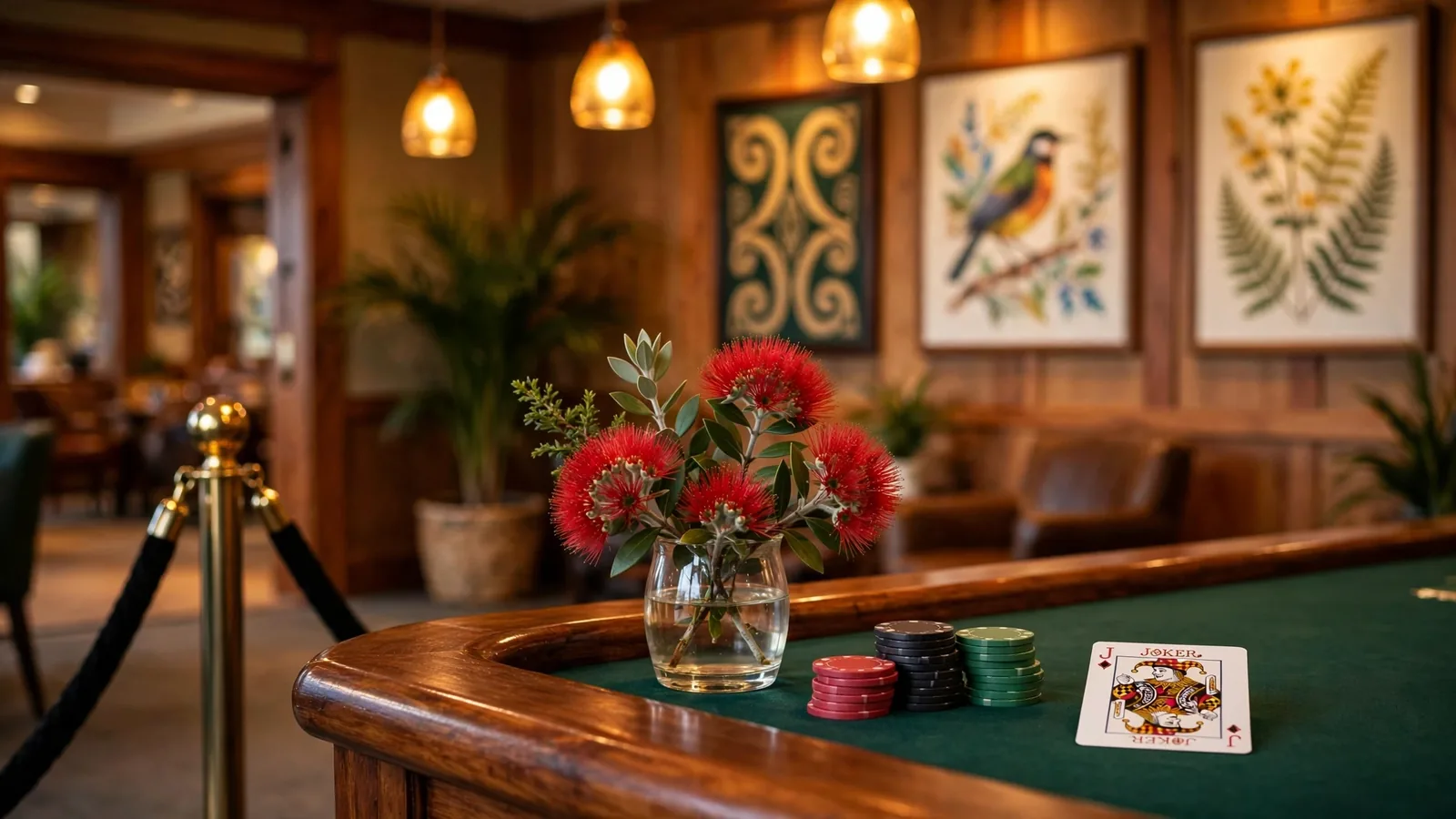
A Large Slot Library Is Only the Starting Point
A large catalogue can make a site look appealing, but the headline count tells you little about whether its pokies suit the way you want to play. A report by grimmagazine.com puts the number of slots available across online casinos in New Zealand at more than 7,000 in 2026. That is a market-wide figure, not a promise that any one casino carries every title or that its selection will stay unchanged.
The useful question is what you can actually find in a particular catalogue. A broad collection may include different visual themes and styles of play, but sheer volume does not tell you how a game works, how quickly its features appear, or how its potential returns compare with another title. Those details need to be checked game by game where they are provided. A striking theme can make a slot memorable; it cannot explain its rules for you.
It also helps to separate range from fit. If you enjoy a particular kind of setting or mechanic, look for that directly rather than assuming a site with a large library will have a strong selection in that area. Searches for Swedish-themed slots, for instance, are best treated as a request for a specific style, not as evidence that a casino has a dedicated or extensive collection. Check the actual catalogue before deciding.
When comparing good online slot sites, consider whether their game menus make it practical to browse and whether the information attached to each title is clear. A long list that is difficult to navigate is less useful than a smaller, organised selection. If a title’s rules or paytable are available, read them before playing; the name and artwork are not a substitute.
Meaningful Comparison
A meaningful comparison starts with what you want to play, then checks whether the relevant titles and their rules are easy to find.
Catalogue size can also change, so treat a published total as a snapshot rather than a permanent feature. Even a site that once offered a particular title may not continue to do so. If you have a specific game in mind, confirm that it is currently listed instead of relying on an old review or a general claim about the size of the library.
The best site for online slots is therefore not automatically the one with the biggest number attached to its catalogue. A meaningful comparison starts with what you want to play, then checks whether the relevant titles and their rules are easy to find. More choice is useful only when it gives you a clearer route to a game that fits your preferences.
Before You Use PayPal or Another Payment Method
PayPal is a familiar option for online payments, but its name in a search or on a payment page does not establish that a particular casino accepts it. Check the cashier or payments page before creating a deposit plan. Look for the method’s name in the list of available options and confirm that it applies to deposits, not only withdrawals. If PayPal is not shown, do not assume that another e-wallet works in the same way.
The sites assessed here accept common methods that include Visa, Mastercard, POLi and major e-wallets. The exact options can matter: a method you already use may be simpler than opening an account with a new provider, while a card or bank-linked service may have its own rules. Read the payment information on the casino’s site and, where relevant, the provider’s terms before sending money.
Currency is another practical point. These sites accept deposits in New Zealand dollars, so you do not need to convert NZD just to fund an account. That removes currency conversion fees, but it does not mean every bank or payment provider will handle a transaction identically. Check your own account terms for any charges or restrictions that may apply outside the casino.
Before entering card or account details, check that the payment connection uses SSL encryption. This technology helps protect personal and financial information while it is transmitted. A padlock symbol or secure connection indicator can be a useful browser signal, but it is not proof by itself that a casino is trustworthy or that every part of its payment process is secure. Treat encryption as one safeguard, not a substitute for checking who operates the site and how it handles payments.
Keep the amount you intend to spend separate from money needed for bills and everyday costs. Confirm the currency and payment method on the final deposit screen before approving a transaction; an error there can be inconvenient to undo. If a payment question arises, use the site’s stated support channel rather than sending sensitive details through an unverified message. Payment choices should be clear before you commit funds, not explained only after a deposit has gone through.
Bonus Wagering: The Cost Behind “No Wagering” Claims
A “no wagering” label sounds simple, but it is worth reading the offer terms before treating it as cash you can withdraw. Wagering requirements specify how much qualifying play is needed before bonus funds or related winnings become withdrawable. An offer advertised without wagering may still have other conditions, so check the full terms rather than relying on its headline.
Wagering Calculation
Determine if the requirement applies to the bonus alone or the bonus plus the deposit.
Multiply the base amount by the wagering requirement (e.g., a 35x requirement on a $100 bonus equals $3,500 in qualifying bets).
Verify if the turnover must be completed within a specific timeframe, such as 7, 14, or 30 days.
A specialist review describes welcome-bonus wagering requirements in the 30x–50x range. The multiplier tells you how many times the relevant bonus amount must be wagered. For instance, a 35x requirement on a $100 bonus calls for $3,500 in qualifying bets. That is turnover, not a prediction of what you will lose or win; the balance can change as you play.
The calculation base matters. A requirement applied to the bonus alone is different from one applied to the bonus plus your deposit. Specialist reviews describe 30x–40x on the bonus alone as fairly standard, while 50x or more is steep. Compare both the multiplier and the amount it applies to: a lower multiplier can still mean substantial wagering if the base includes your deposit.
Time limits can add pressure. Specialist reviews cite terms with deadlines of 7, 14 or 30 days. If the requirement is not completed by the stated deadline, the bonus or associated winnings may be forfeited under the offer rules. Check when the clock starts and whether every game contributes equally; qualifying games and contribution rates should be set out in the terms.
Also look for a maximum stake while the bonus is active. Specialist reviews report caps such as NZ$5 per spin, while other reported offers set limits around NZ$5–NZ$8. Exceeding a stated cap can put winnings at risk. Do not assume a larger bet will help finish wagering faster: it may breach the offer conditions.
For gambling sites offering slots, “no wagering” is not a substitute for checking restrictions on withdrawals, eligible games, expiry and stake size. If the terms are unclear, or the arithmetic is difficult to verify, leave the offer alone. A bonus is optional; the conditions are not.
Starting Out, Verifying Your Account and Playing on Mobile
Getting started at an online casino is a sequence rather than a single sign-up step: create an account, confirm your details, add funds, choose a game and play. Taking time to enter accurate information at the start can make later checks easier, particularly when you request a withdrawal.
Create an account with accurate details
Registration forms commonly ask for personal and contact details. Use information that matches your identity documents, and check for errors before submitting it. A mismatch between your account details and your documents can lead to questions when the operator checks your identity.
Online casino play in New Zealand is for adults aged 18 and over. Keep your sign-in details private, and avoid using an account that belongs to someone else. Once registration is complete, follow any prompts to verify your details. Verification may not be required at the same point for every player, but it is part of the process operators use to establish who is using an account.
Verification may happen before a withdrawal
Your first withdrawal commonly prompts a Know Your Customer check, usually shortened to KYC. The operator may ask you to provide photo identification and proof of your address. It may also request proof that you own the payment method used on the account.
Account Verification
- Enter personal details that match identity documents
- Provide clear, readable copies of requested ID
- Submit proof of address
- Provide proof of ownership for the payment method
Prepare clear, readable copies of requested documents and submit them through the operator’s stated process. If a document is missing, unclear or does not match the account information, the check may remain incomplete until the issue is resolved. Specialist casino reviews report that verification at many pokies sites available to New Zealand players can take 24–48 hours, but that is a reported timeframe, not a guarantee for an individual account.
A withdrawal can also be held while an active bonus remains attached to the account and its wagering conditions have not been completed. Read the offer terms before accepting a bonus, and check your account status before requesting payment. The practical point is simple: a withdrawal request does not necessarily mean the checks or account conditions are finished.
Add funds only after checking the account
Once your details are in place, review the deposit options shown in your account and choose one you understand. Check the transaction amount and currency before confirming, and keep a record of the payment. Do not assume that an option displayed elsewhere will be available to you; rely on the methods actually shown by the operator.
If you intend to withdraw through a particular method, check the relevant account and payment instructions beforehand. Operators may ask for proof of a payment method during KYC, so using details that do not belong to you can complicate verification. If anything about a transaction is unclear, contact customer support before sending funds.
Choose a game and use a device that suits you
After funding the account, browse the available games and select one. Check the game’s displayed rules and controls before placing a bet, so you know how to start, adjust a stake or leave the game. Set a firm stopping point before you begin, and do not chase losses.
Most online casino platforms are designed to work on mobile devices, allowing you to use them at home or while travelling. A mobile layout can make account pages and games accessible on a smaller screen, but it does not remove the need to check details carefully. Confirm the amount before betting or depositing, and take extra care when reviewing documents or withdrawal instructions on a phone.
The same basic steps apply whether you use a computer or mobile device: register, verify your details, deposit, choose a game and play. If a first withdrawal is delayed, check whether the operator has requested documents, whether every submitted file is readable, and whether any bonus conditions remain attached to the account.
Free Slot Play: Know What the Available Facts Can—and Can’t—Tell You
“Free play” can refer to different things: trying a game without staking cash, or receiving spins as part of an offer. The label alone does not tell you which one a site means, whether a particular game has a free mode, or whether an offer is available to you. Check the site’s own description before creating an account or making a deposit; do not treat a general reference to free slots as proof that a specific option exists.
The basic route through an online casino is to create an account, verify your details, deposit funds, select a game and play. That sequence describes how real-money play starts. It does not establish that the site also provides a practice mode or free spins. If you are looking for a way to try a game without paying, confirm that the site explicitly describes that feature and explains how it works.
Also distinguish access to a game from the terms attached to any promotion. A free-play label is not, by itself, a promise that winnings can be withdrawn or that no conditions apply. Read the relevant explanation on the operator’s site rather than relying on a category name or a search result.
If no clear description is available, treat free play as unconfirmed. You can still assess what the site says about account creation and game selection, but those steps do not guarantee a no-cost option. A precise description matters more than a tempting label: it lets you know whether you can simply explore a game or are being asked to take part in a promotion.
Are online pokies legal in New Zealand?
Yes, you can legally play at internationally licensed online casinos. The Gambling Act 2003 targets operators running online casinos from within New Zealand, not individual players.
Are gambling winnings taxed in New Zealand?
No. Recreational gambling winnings are generally not taxed in New Zealand.
Can I use NZ dollars at offshore casino sites?
Yes, many offshore casinos accept NZD. Check the site’s payment information to confirm its supported currency and any conditions.
Published by the Casinosbonusesinfo team.